
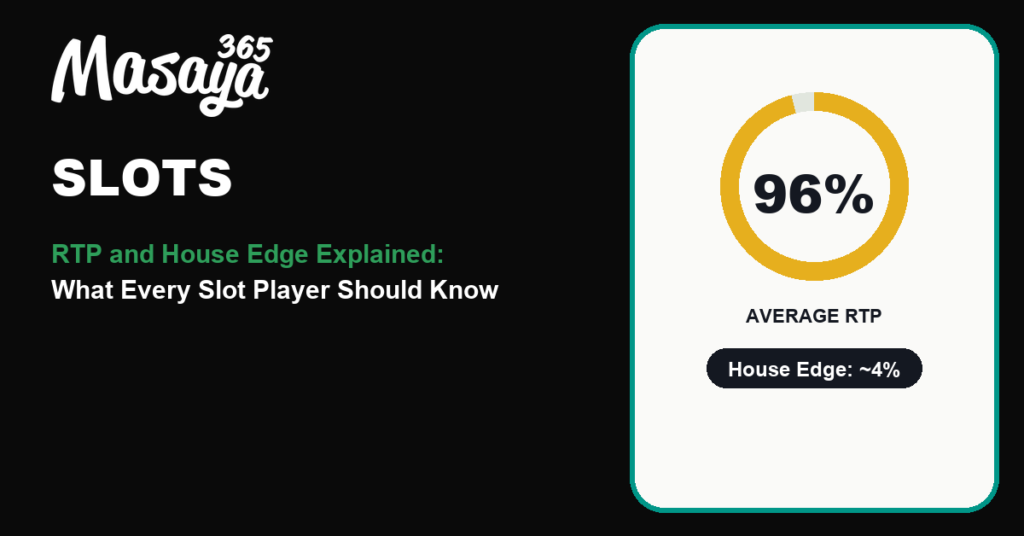
Short answer: RTP tells you what a slot pays back on average over millions of spins – it says nothing about any single session. House edge is the same number viewed from the casino’s side. Neither predicts what happens in the next hour you play, and confusing that with how the numbers actually work is the single most common misunderstanding among new slot players.
RTP and house edge are the same fact, two directions
A slot with 96% RTP has a 4% house edge. These are not two separate numbers to learn – they are the same figure, stated from opposite sides of the table. RTP tells you your long-run expected return; house edge tells you the casino’s long-run expected margin. Add them together and you get 100%, always.
Most licensed online slots sit between 94% and 97% RTP. That two-to-three point spread sounds small, but compounded across thousands of spins it meaningfully changes your expected losses over a long session.
What RTP does not tell you
RTP is calculated over the full theoretical lifetime of a game – typically millions of simulated spins. Your Saturday night session is a tiny, noisy sample of that. A 96% RTP slot can hand you a losing streak or a lucky jackpot inside one hour; both outcomes are fully consistent with a 96% long-run average. RTP is a planning number, not a promise about your next spin.
Where volatility changes the picture
Two slots can share identical 96% RTP and feel completely different to play, because of volatility – how the payouts are distributed, not their average size.
- Low volatility. Frequent, small wins. Your balance moves in small steps. Suits a longer session on a fixed, modest budget.
- High volatility. Long dry stretches broken by rare, large wins. Your balance can fall steadily before one spin changes everything. Needs a bigger buffer to survive the dry stretches and reach the big win.
Matching volatility to your bankroll matters more than chasing the highest RTP number. A small bankroll on a high-volatility slot is the most common way players bust out fast despite a perfectly respectable RTP. RTP and volatility belong to the whole game, so the number of paylines or ways does not change them; we explain how slots count a win in slot paylines, ways to win and cluster pays.
Table games have a house edge too – just structured differently
House edge is not exclusive to slots. Blackjack played with correct basic strategy can carry a house edge under 1%, among the lowest in any casino game. European roulette sits around 2.7%. American roulette, with its extra double-zero pocket, rises to about 5.3% – a real difference driven by one extra number on the wheel.
How to actually use this information
- Check a game’s RTP before committing a session’s budget to it. Most licensed platforms list it in the game’s info panel.
- Match volatility to your bankroll, not to the marketing. A small budget survives longer on low volatility.
- Treat RTP as a long-run average, never a short-term prediction. No streak, hot or cold, changes the underlying math for your next spin.
- Set your budget before you start, not while you are ahead or chasing losses. The math never favors the player long-run; the only thing you fully control is how much you risk finding that out.
RTP and house edge also explain why slots and table games are weighted so differently in wagering contribution rates bonus terms.
Frequently asked questions
What is a good RTP for a slot machine?
96% or higher is generally considered favorable among licensed online slots. Most fall between 94% and 97%. Always check the specific figure in the game’s info panel rather than assuming.
Does high RTP mean I will win more often?
Not necessarily. RTP is a long-run average across millions of spins, not a short-term prediction. Volatility, not RTP, determines whether wins arrive often in small amounts or rarely in large ones.
Which casino game has the lowest house edge?
Blackjack played with correct basic strategy typically carries a house edge under 1%, among the lowest of any casino game. European roulette follows at around 2.7%.
Why do two slots with the same RTP feel so different to play?
Because RTP measures average return, while volatility measures how those returns are distributed – frequent small wins versus rare large ones. Two slots can share an RTP and still play very differently.